Showing posts with label Relativity. Show all posts

Monday, February 9, 2009

Scorpion claws similar to Anomalocaris?


Did Anomalocaris really go extinct? 

Origin of claws seen in 390-million-year-old fossil
Scientists have puzzled over the origins of the paired grasping appendages found on the heads of scorpions and horseshoe crabs. The researchers suggest that Schinderhannes gives a hint. Their appendages may be an equivalent to those found in the ancient predatory ancestor, Anomalocaris — even though creatures with those head structures were thought to have become extinct by the middle of the Cambrian Period, 100 million years before Schinderhannes lived.


Tuesday, January 27, 2009

Shaking up the Tree of Life


Earth may have given rise to two distinct groups of animals:
bilaterians -- animals with bilateral symmetry, like humans -- and
non-bilaterians, which include corals, jelly fish, hydra, unusual,
often poisonous, creatures known as cubozoans, and other organisms.

Ancestor For All Animals Identified : Discovery News
Although non-bilaterians and bilaterians appear to have followed separate evolutionary paths, nervous systems appear in both groups. Placozoans and sponges don't possess them, but many of their closely related taxa do.

"So this means that if our work is right, nervous systems evolved twice: Once in the lineage leading to bilateria and once in the lineage leading to corals, jelly fish, hydra and cubozoa," he said.

Tuesday, October 21, 2008

Evolution's other big driver


Sometimes its no survival of the fittest ... its just survival that matters.


'Space invader' DNA infiltrated mammalian genomes - life - 20 October 2008 - New Scientist
The team thinks that the hAT transposon invasion occurred about 30 million years ago and spread across at least two continents. "It's like a pandemic, and one that can infect species that weren't genetically or geographically close. It's puzzling, scary almost," Feschotte says.

It may not be a coincidence that the time of the invasion coincides with a period in evolutionary history that saw mass mammal extinctions. This is usually attributed to climate change, Feschotte says, but it is not crazy to suppose that this type of invasion could contribute to species extinction.

The hAT transposon does not occur in humans, but some 45% of our genome is of transposon origin.

Thursday, September 18, 2008

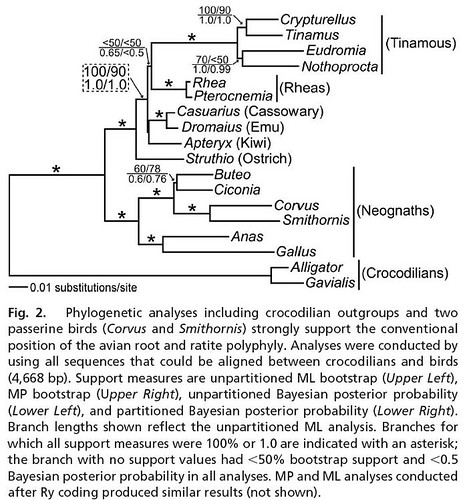
Ostriches more ancient than previously thought


A good article on how different types of birds related.


Living the Scientific Life (Scientist, Interrupted): Ratite Flight: Lost But Not Found
Additionally, if you look closely at the above phylogenetic tree, you will notice that it is the ostriches that are the sister group to all the other ratites, not the tinamous, as originally thought.

Further, these phylogenomic relationships remain unchanged after adding crocodilian DNA (crocodiles are the sister group to birds) and DNA from two additional neognath groups (figure 2);

Wednesday, January 23, 2008

Eukaryotes Reclassified into Four Branches


'Tree Of Life' Has Lost A Branch, According To Largest Genetic Comparison Of Higher Life Forms Ever
“The results were pretty astounding. All non-bacterial life on Earth—called eukaryotic life— can now be divided into four main groups instead of the five groups that we have been working with up to now,